Exploring the abyss: technology, life, sound, and motion.
Why Explore the Deep?
The deep ocean-everything below 200 meters-remains one of the least explored regions on Earth.
Despite covering more than half of our planet's surface, it is cloaked in perpetual darkness,
intense pressures, and near-freezing temperatures. Yet, this extreme environment holds keys to
understanding climate regulation, plate tectonics, novel forms of life, and future innovations
in medicine and materials science.
Deep sea exploration is a multidisciplinary effort where engineering meets biology, chemistry
meets geology, and data science meets stewardship. Sonar mapping, ROVs, AUVs, and advanced
sensors allow us to study habitats once unreachable. As you explore this site, you'll see how
these technologies work, meet organisms adapted to eternal night, and experience the deep
through audio and video.
Vessels & Technology
Early bathyscaphes pioneered human travel into the abyss.
Human-occupied vehicles (HOVs), like early bathyscaphes and modern titanium-hulled submersibles,
place researchers directly at depth. Remotely operated vehicles (ROVs) and autonomous underwater
vehicles (AUVs) extend reach even further, mapping seafloors, collecting samples, and capturing
high-definition video.
Supporting technologies include multibeam sonar, synthetic aperture sonar, Doppler velocity logs,
acoustic navigation beacons, LED lighting arrays, and advanced sampling tools. These innovations
turn the deep from a black box into a place we can systematically survey and understand.
Life in the Abyss
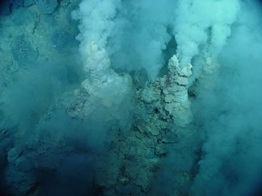
Without sunlight, deep sea ecosystems rely on chemosynthesis. Hydrothermal vents eject hot,
mineral-rich fluids that support microbes forming the base of food webs. Tube worms, vent crabs,
shrimp, and specialized fish thrive in these extreme environments.
Adaptations include pressure-resistant proteins, bioluminescence, oversized or absent eyes,
slow metabolism, and long lifespans. Studying these organisms expands our understanding of
biological possibilities and informs conservation of fragile deep habitats.
Listen: Sonar & the Soundscape
Sonar reveals seafloor features and organisms in darkness. Passive acoustic monitoring captures
whale calls, cracking ice, earthquakes, and ship noise-helping researchers track migration and
ecosystem change.
Sound & Motion
The Mariana Trench, nearly seven miles deep, is shaped by immense geological forces. Despite
crushing pressure and freezing temperatures, life thrives in surprising forms.
Human exploration-from the HMS Challenger to the Trieste and James Cameron's solo dive-
reveals resilient creatures adapted to the most extreme environments on Earth.